

The Role and Impact of the Film Editor: Insights from Walter Murch’s In the Blink of an Eye
By Ajijul Hasan Surzo (6th February 2026)
Introduction
A film editor is basically a hero in the entire filmmaking process, taking all that raw footage and turning it into something that actually makes sense and feels right. Walter Murch puts it so well in his book In the Blink of an Eye. He says the editor is often the first person to see the big picture, deciding what to keep and how to shape what we all end up watching. It’s way more than just cutting and placing clips together. It is about building the rhythm, the tension, for the sake of the story and the emotion. I recently rewatched The Cutting Edge: The Magic of Movie Editing, this documentary directed by Wendy Apple about the whole history and art of film editing, and read the revised second edition of Murch’s book, and it really opened my eyes again in some other aspects of film editing that i overlooked in first time. The documentary is full of interviews with editors and directors, and they show clips from old movies to new ones to prove how editing can completely change everything. Murch’s ideas, especially putting emotion first, gave me a perfect way to look at it all. In this paper I’m gonna talk about what editors’ hidden skills bring the audience attention in the film and why it matters.
The Role and Impact of the Editor on a Film
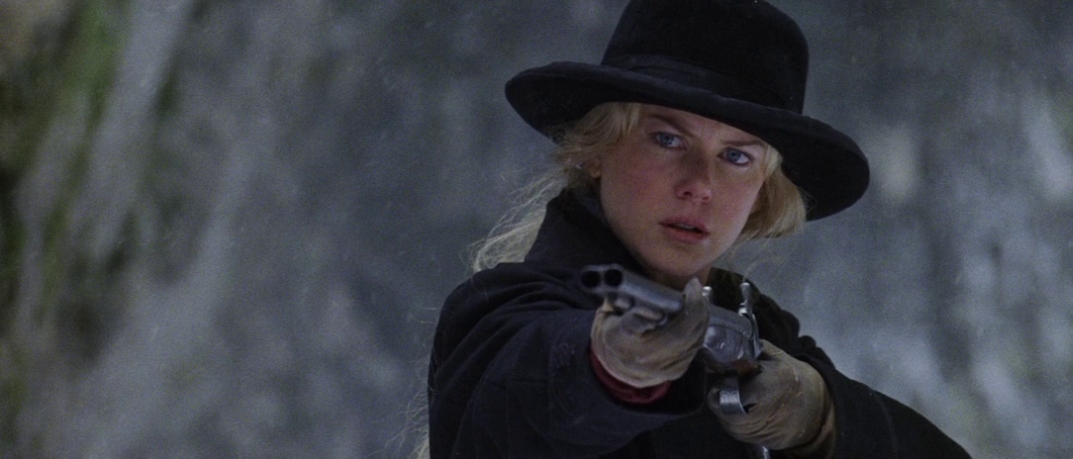
The editor is like the last but the most important storyteller who comes in and fixes the director’s vision after everything is shot. They usually work all alone with tons of footage, picking the best takes, timing the cuts by matching continuity, and putting sequences together that pull the audience through every feeling. Murch describes it as this intuitive thing, like sculpting, where you keep trying stuff until the real movie shows up through all the experiments (Murch 17). You can see exactly what he means in The Cutting Edge: The Magic of Movie Editing. They have editors and directors of biggest films talking about their process, and the coolest part is watching Walter Murch stand up at his desk and actually edit a scene from Cold Mountain while they film him. He marks a frame, plays it back, marks it again, checks it twice more, you can literally see him deciding the exact right place to cut. The documentary also throws in all these clips from films like the car chase from Bullitt or Matrix fight scenes to show how editing creates excitement or meaning that just wasn’t there in the raw shots.
People who have seen the documentary say it’s this amazing behind the scene of something most of us never think about. It makes you realize editors are the ones who hide mistakes, build tension, and separate pieces into one flowing story. Without good editing even great acting and shots can feel flat. The documentary itself is edited so smoothly that the interviews and clips just flow together and teach you without feeling it a lecture.
Murch’s Theories and Approach to Editing
Murch’s whole philosophy feels both super organized and really human at the same time. He compares a cut to blinking your eyes. A quick little pause when your attention shifts, so the edit feels natural and doesn’t kick you out of the moment (Murch 63). That’s why really good editing is invisible. You don’t even notice the cuts because they happen right when you would naturally look away or refocus. The whole idea of human eye blinking is pretty much the same as a cut in editing, and the philosophy behind it is that we blink our eyes every time there’s a shift, like when we’re talking or looking at something new, and a cut works exactly the same way in a film. If the cut is in the perfect spot, the entire audience in the theater will actually blink together at the same time.
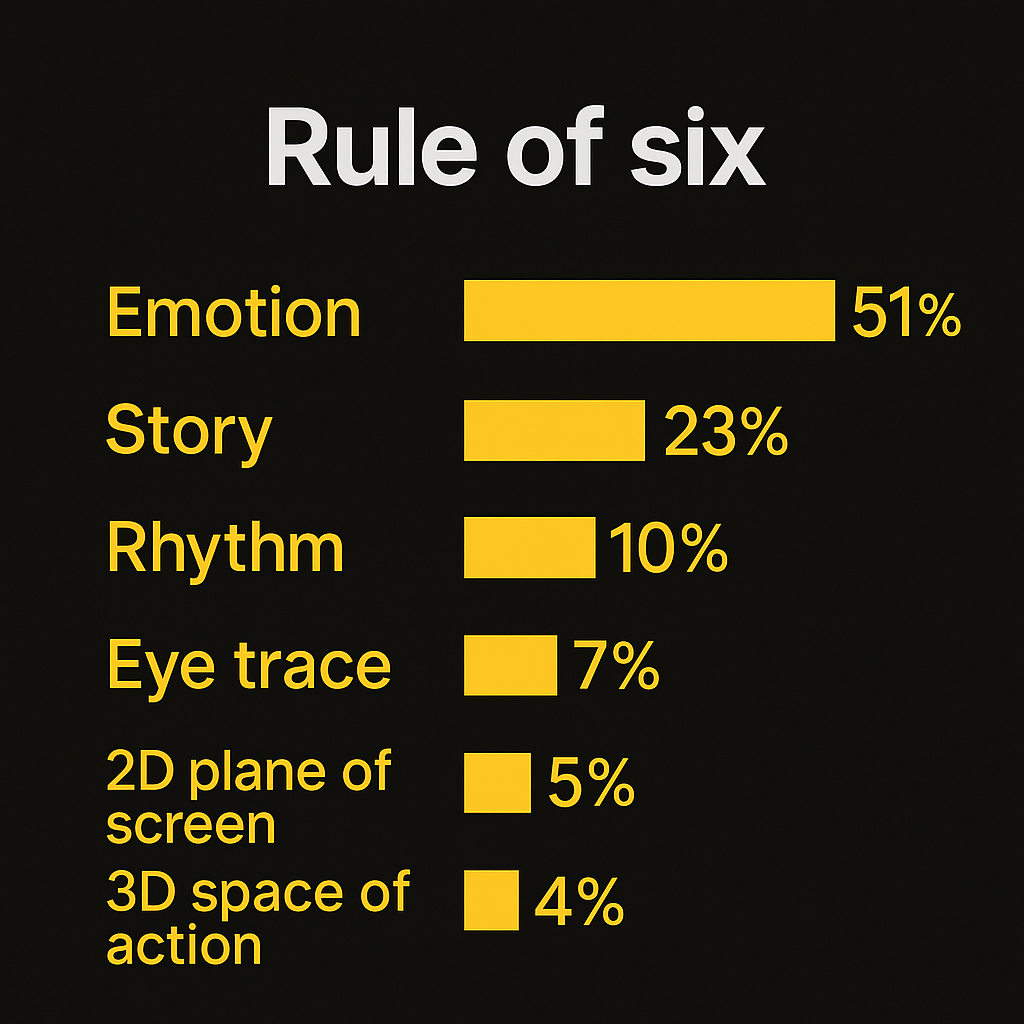
His “Rule of Six” is what makes a cut good.
- Emotion (51%): Does the cut capture the right feeling or mood of the moment?
- Story (23%): Does it help move the plot or narrative?
- Rhythm (10%): Does it happen at a spot that feels musically or timing-wise interesting?
- Eye-trace (7%): Does it guide where the viewer’s eyes are focused in the shot?
- Two-dimensional plane of screen (5%): Does it respect the flat screen’s rules, (often called the 180 degree rule) like which way characters are facing?
- Three-dimensional space continuity (3%): Does it keep the 3D world feeling real and consistent, like positions in space?
(Murch 18-19).
Applying Murch’s Ideas to Contemporary Films
He says the perfect cut hits all of them, but if you have to pick, emotion wins every time. This explains why some films are just flow and you never think about the cuts. They support the story very well that taking them away would destroy everything. Even now with digital editing where you can cut many times, Murch still says stick to emotion over fancy tricks. In the second edition he talks about how all the new tools are amazing but you have to have discipline so you don’t over-edit (Murch 71-72). I really connect with this because it keeps the whole thing about real human feelings instead of just a rule of editing.
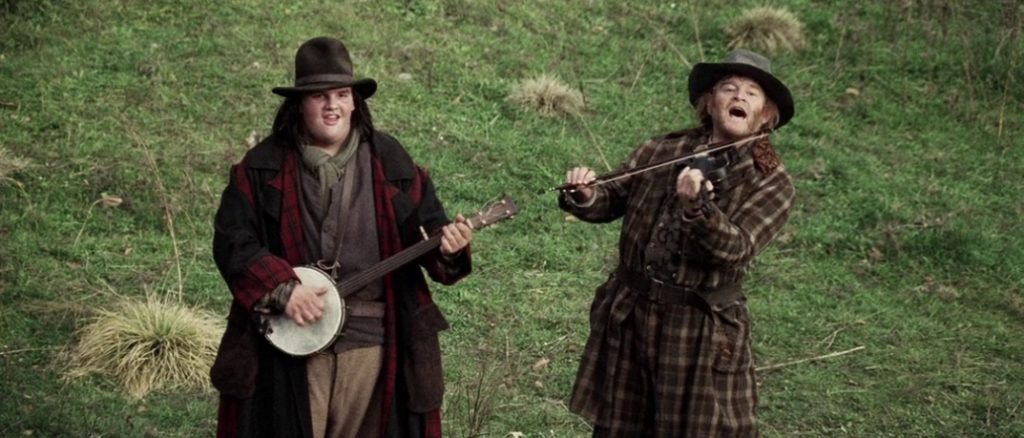
(Film-Cold Mountain 2003)
Murch’s ideas are so brought that it still works today. You can see them working in the documentary when they show him editing Cold Mountain, picking cuts based on emotion and story, just like his rule of six.
But the biggest thing I realized after watching Cold Mountain is this.I often forgot that I was watching it to understand the editing, but it was so well-crafted that I became very connected to the story and missed the opportunity to appreciate the editing aspect. And that exactly means, when the editing is really good you don’t even notice it. You just get pulled into the story and the emotion. You forget there are cuts. The same thing happened with One Battle After Another that I recently watched. That film keeps you locked in the whole time. You won’t even think about going to the restroom.
Action cuts are matched for continuity or timed to the beats and music but almost everything else is built to connect you to the emotion and push the story forward. Even when the 2D screen rules or strict 3D space continuity aren’t perfect the editor still makes a 3D world feel real in your head. The cuts and the camera let your eyes travel through the characters’ minds and the space. Almost like you’re inside their feelings.
A great example is the campfire scene in Cold Mountain where Ruby’s dad Stobrod and his friend Pangle are asked to play music by Teague. And Teague starts singing along too. For a moment it feels almost warm. You almost start to think maybe Teague has some human side like he’s one of us or at least feels something normal inside. The editing stays soft and rhythmic here matching the song keeping you in that hopeful little moment. But then Teague tells them to step aside. The rhythm changes. Cuts get sharper faces shift Stobrod’s expression goes from soft to shocked. Suddenly the truth hits hard. The editing pulls you out of that soft corner and slams you back into the brutal reality. It works so well because it follows Murch’s Rule of Six. Emotion 51 percent and story 23 percent lead everything. The lower rules like exact space or screen direction don’t matter as much. The cut just guides you through the characters’ minds and the director’s plan. The editor makes you feel exactly what they want you to feel.
A similar thing happens in One Battle After Another. The whole movie keeps asking whether Perfidia was a rat or a hero and it never lets go of that emotional question from Willa. In the church DNA scene where Willa confronts Steven and asks if he raped her mother shes discovering huge painful truths about her life. The editor stays on those closeups letting them breathe, cutting between faces and reactions in a way that feels completely driven by emotion and story. No rush, no flashy moves just holding on those moments so you really feel the weight of what she’s learning. It builds that confusion, pain and connection perfectly.
Then in the final scene with the wavy roads and the car following them you’re wondering how its all going to end.
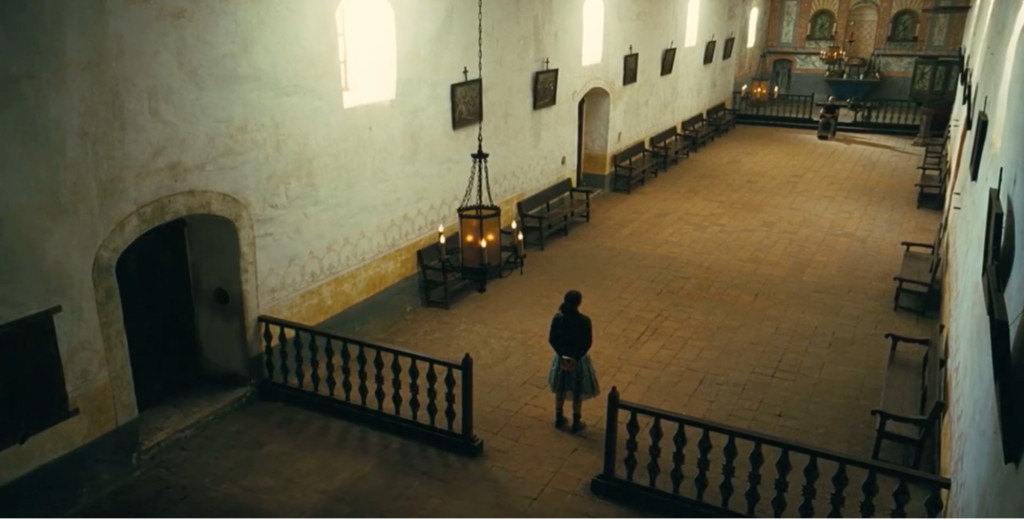
(Film-One Battle After Another 2025)
The editing keeps the rhythm slow and thoughtful, matching the distance and the road letting your mind travel with them. When it actually ends its so real and unexpected that I couldn’t even guess it ahead of time. That’s definitely the director’s vision but the editor used the Rule of Six to make it land. Emotion and story always win even if some continuity gets bent. The cuts guide you through the feeling and thats why it stays with you.
This is exactly how Murch’s blink theory works too. The cuts happen right when you naturally blink or refocus in real life. You don’t notice them because they match how we actually think and feel, not how the camera is supposed to move.
Conclusion
At the end of the day the editor has a superpower. They take all these separate pieces of footage that are messy and bad and turn them into something that can actually move people and stay with you long after. Walter Murch’s book In the Blink of an Eye, especially the Rule of Six and the blink idea gives a really clear way to understand how it works. Always start with emotion and story. Everything else comes after. From watching The Cutting Edge: The Magic of Movie Editing and seeing real editors at work especially Murch himself to the way cuts disappear in Cold Mountain and keep you glued in One Battle After Another his ideas show how editing is this invisible art. You don’t see it but you feel it completely. Even with all the fast digital cuts and crazy action in newer movies Murch keeps reminding us it’s still about the human part. That’s what makes a film hit hard and it lasts.
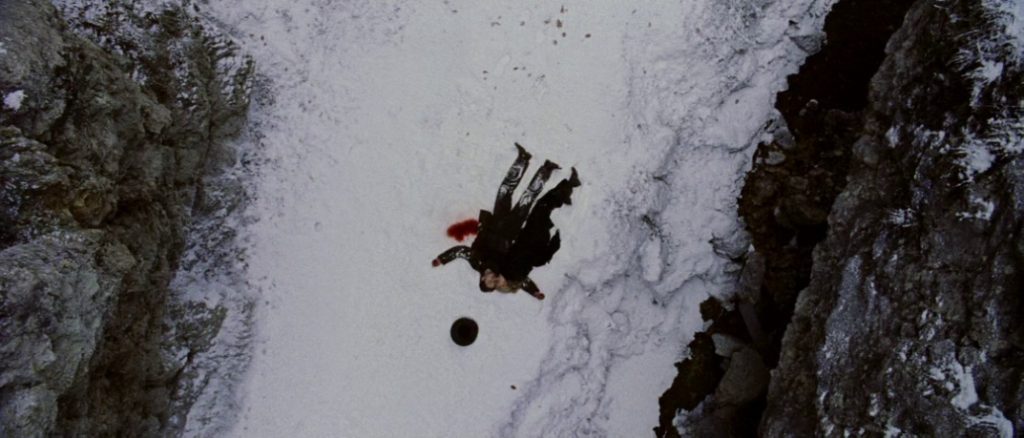
(Film-Cold Mountain 2003)
Works Cited
The Cutting Edge: The Magic of Movie Editing. Directed by Wendy Apple, American Cinema Editors, 2004.
Cold Mountain. Directed by Anthony Minghella, performances by Jude Law, Nicole Kidman, and Renée Zellweger, Miramax Films, 2003.
Murch, Walter. In the Blink of an Eye: A Perspective on Film Editing. 2nd ed., Silman-James Press, 2001.
One Battle After Another. Directed by Paul Thomas Anderson, performances by Leonardo DiCaprio, Chase Infiniti, and Sean Penn, Warner Bros. Pictures, 2025.
How Editing Saved Star Wars: Intercutting, Clarity, and Walter Murch’s Rule of Six
By Ajijul Hasan Surzo

Los Angeles Videographers: Premier Video Production for All Your LA & SoCal Needs
When searching for exceptional Los Angeles videographers, you need a team that not only understands the diverse

Los Angeles Videographers: Craft Films LA’s Innovative Approach Across Southern California
Need a compelling video in Los Angeles or Southern California? Whether it's to grow your business, capture